Clayground News

We are thrilled to announce Clayground Collective is winner of an inaugural national Craft Skills Award in the category Engaging New and Diverse Audiences.  The citation says the award recognises: “commitment towards excellence, success, ambition, and exemplary and imaginative approaches in passing on craft skills”.  We are delighted to have Clayground’s work recognised in this way and appreciate the great number of people with amazing skills and expertise who have enabled us to  devise imaginative ways to get people stuck into clay, whatever their perspective.

The Awards were presented by HRH Prince of Wales on May 2nd to:

  • Celebrate the great work that is already being done in craft to support future makers’ development.
  • Encourage others to get involved and support the next generation of makers by passing on their skills.
  • Raise the public profile of craft, and its status, and encourage people to consider it as a career choice.

The winners cover a huge range of skills from boatbuilding and embroidery, to silver and blacksmithing, calligraphy to parchment making.  Watch a great film about how some of these skills are being passed on.  Keep your eyes open for next year’s Awards and nominate someone who is passing on their skills to others, young or not so young.  It might be you!

The Awards are organised by Creative and Cultural Skills, the licensed sector skills council for the UK.  Here’s a photo of the award presentation, L to R: Duncan Hooson, Julia Rowntree, HRH Prince of Wales, Kirstie Allsop.

Craft Skills Awards 5 (Duncan Hooson and Julia Rowntree Clayground Collective)


LIFE ON MARS? Clay reveals its evidence

Clayground adviser, mineralogy researcher Javier Cuadros, gives us the latest news of his research into clays on Mars, the background arguments to where the Curiosity rover has landed and where it is searching for evidence of life.

Liquid water was relatively abundant on Mars in the early stages of its history, as shown by numerous ancient clay outcrops. This suggests the possibility of life. The Curiosity rover is investigating habitability, which means investigating rocks where life could have existed or may exist even now. Curiosity moves very slowly on the Martian surface and can only cover a small area, so it will take time for it to hit on evidence of life if it is there or ever was.  It may never succeed in doing so.

In the meantime, we have an enormous dataset collected by the several satellites orbiting Mars and used this to investigate whether it might be possible to search underground for remains of life. First of all, we argued, life on Mars is as much or more probably to be found underground than on the surface. Why?

Here on Earth, the amount of biomass underground is the same as that on the surface. Think of it: there is a living world underground as big as the one you see on the surface of the continents and in the oceans, made up exclusively of microorganisms. We also know that some of these microorganisms are among the oldest forms of life on Earth. So it is possible that life on Mars could have also developed underground. And there is good reason: conditions at the surface have been very harsh. Mars has been very cold, dry and bombarded by high-speed particles from the Sun for a long period of time. Life on the surface in these conditions is impossible. Underground however, microorganisms may have found a protected environment.

We used satellite data to investigate deep impact craters that may have excavated rocks inhabited by microorganisms. One of the craters we found has features suggesting groundwater upwelling. That is, a meteorite impacted Mars excavating a huge crater and then underground water seeped into the crater, half way from its walls, as seen in the satellite photographs. The crater also contains clays and carbonates, indicating the water seeping out had the right type of chemistry to support life. We proposed that this and similar craters, although not abundant, are good candidates for future Mars expeditions focusing on habitability. There, the rovers could investigate sediments derived from underground waters. Because the sediments are clay-rich, they are good preservers of remains of life. Clay does not only provide an environment suitable for life to develop but also preserves dead organisms from complete degradation and disappearance.

Mclaughlin craterMcLaughlin crater on Mars. The arrows indicate possible channels generated by seeping water. The black lines show lobes interpreted as sediment deposited by the waters seeping into the crater and forming a lake. Keren Crater, below, formed later by another impact.

For anyone wishing further information, see the article by Joe Michalski, Javier Cuadros and colleagues published in Nature Geoscience: ‘Groundwater activity on Mars and implications for a deep biosphere.’ Nature Geoscience 6, 133-138. doi 10.1038/ngeo1706.


Thames foreshore fragments and visual references

At Clayground we like to think we are encouraging people to make future archaeology by getting involved in clay today.  We work with archaeologists to delve into London’s collections to illuminate the capital’s amazing history and inspire contemporary makers and ceramic appreciators.  Many ceramic items can be found in the collections of the Museum of London and local museums across the capital; some are in London’s archaeological archive and some are just lying around on the Thames foreshore.

With leading Thames archaeologist, Mike Webber, we conducted walks on November 17 and 18 to gather some of these traces of London history.  We will be conducting further walks next year at some point.  Please let us know if you would like your name to be added to the waiting list.

We certainly found some treasures in November.  Each fragment, its clay, the use and type of glaze, opened a window onto the social, technological and trading history of London.  We saw traces in clay of human fingers, some small enough to be those of a child, often employed for long hours in London’s potteries.  In another, the imprint of a potter’s fingernail could be made out.  We found clay pipes aplenty; fragments from Roman domestic pots (no glaze/ greyish clay); medieval pottery with sparse green glaze on the outside; no less than two tile pieces from Tudor heating stoves (lovely green glaze and terracotta clay); the finial from a Tudor money box (green too); fragments of decoration from Bellarmine ware (brownish  salt glaze called “orange peel”) and bits of creamy white Victorian dairy crocks.  The money box probably once containing the takings from theatres on the south bank ferried across the river to be banked in the City.  The clay pipes were doubtless dropped by men waiting on the piers for cargo to arrive or enjoying a well-earned beer at one of the many riverside taverns.  We found evidence of London life in other materials too: bones, metal, wood, 17th century shoe leather and abalone shell fragments, waste from a button-making factory.

Tile from a Tudor heating stove with figure from a coat of arms
Finial from Tudor money box

Here are visual references prepared by Mike to help you identify any sherds you may come across.  (sherds = pottery; shards = glass fragments).

Clayground Collective

Clayground News September 2012

What a summer!  Amidst the joys and emotional roller-coaster of the Olympics, Clayground has been busy with things clay, working with youth arts organisation Project Phakama on Earth Exchange; with the Museum of London on a workshop for families inspired by the archaeological ceramic collection; with Morley Gallery on a marathon two week installation inspired by London 2012; and finally, with Global Generation, Kings Cross, on a summer school about clay and the Big Bang.

Take a look at the Flickr photostream to the right for images of these activities and the auction we ran with Phakama to support beginners’ bursaries for Phakama participants at Morley College.

We’ll be posting news soon about Clayground events and you’ll find below the latest news on bio-clays research from Javier Cuadros, our clay mineralogy adviser.

How is clay formed? Is it inorganic or organic?

Javier Cuadros, Clay Mineralogy Adviser to Clayground Collective, explains the latest findings.

Clay is the product of chemical reaction between silicate rocks and water. Different types of clay and their different physical and chemical properties are determined by their individual chemical composition and structure. Two well-known clays are kaolin and “expansive clay”. Kaolin is used in numerous industrial applications, but it is best known for being the main component of china clay. Expansive clay is a group of minerals we refer to as “smectite” that expands through absorption of water within their structure. Smectite also has many industrial applications, but creates great problems in construction because it absorbs and releases water depending on environmental conditions.  This can result in ground movement with catastrophic effects on buildings.

So how do these very different types of clay form? Why does sometimes kaolin and sometimes smectite form, or indeed any of the many other clay minerals? Most research into this question has focused on inorganic factors including: composition of the original silicate rock, chemistry of the waters producing chemical attack of the rock, temperature, water pH, etc. Temperature can refer to the ambient atmospheric conditions, the temperature of rainwater attacking the rock, or to attack by waters from a specific source such as a hot spring. Today, the inorganic conditions producing the various types of clays are reasonably well understood.

One thing is missing, however: life. Living organisms, particularly microorganisms, have been around for most of the lifetime of the Earth. How important are they in the processes that generate clay? How much of the clay around us is like it is because life is “interfering” with it? Imagine, for example, that bacteria literally cover the surface of every rock or mineral grain on Earth, from the surface down to as much as 3 kilometres below the surface. Life forms are so different and their activity so complex that this information is very difficult to gather and systematize. We are only very slowly making headway.

Recent research by me and other collaborators has investigated the reaction of waters of very different chemistry and microbial populations on volcanic glass. Microbes thrived happily in the experiments as can be seen in the photo below: where the black sand shows volcanic glass and the whitish fluffy stuff are the microbial colonies.

When looked at using an electron microscope, one could see how the microorganisms stuck to the glass grains, as in the pictures below, where you can see cells and biological tissue on glass (the very smooth surface on the picture at the left) and other mineral surfaces (polygonal shapes on the right-hand photo). Everything in these pictures is micro-metres in size (1 micro-metre is 1 millionth of a metre).

Was there some effect as a result of this contact? Well, not always, but at other times there was. The main effect observed was the microbes generating a “biofilm” eventually enclosing all the glass grains seen partly developed in the top colour image. At the end of the experiments, the entire mass of the glass grains formed a single body due to this entrapment by the microorganisms. In some cases, the chemical conditions within the biofilm were rather different from those in the water outside, and the clay that formed was also different from the clay formed in control experiments that had no microbes, only the glass and the water.

What sort of clay formed? This was mainly smectite, but with different chemical compositions, and some kaolin here and there. The specific composition of the smectite is very important to understand the life-cycle of rocks. The effect of having smectite with a lot of aluminium is very different from having smectite with a lot of magnesium. This is exactly the difference that the microorganisms made in the experiments. In nature, smectite clays of different composition are expected to come from different environments. But this experiment shows that microorganisms can create a different environment at a very small scale, next to the rock that is chemically attacked, and can effectively override the large-scale environmental conditions.

You will be happy to know that clays containing both aluminium and magnesium are good for modelling, although they do not behave exactly the same when fired.

Watch out for news in the coming months about clay as an indicator of life on Mars.


Clay on Mars, evidence of life?

Javier Cuadros, Clay Mineralogy Researcher at the Natural History Museum advises Project Clay.  Javier will in due course analyse information returning to Earth from Mars.  Here he explains the significance of clay as an indicator of life.

The Mars Science Laboratory (MSL) continues its voyage and will land on Mars on August 6th at 5:10 am GMT. If you want to follow its approach, see http://mars.jpl.nasa.gov/msl/

One of the mission’s goals is to investigate habitability on Mars, which involves looking for evidence of past life. The Curiosity rover will have to search for organic remains in the sediments. Organic material is quickly destroyed and their constituent elements incorporated into inorganic sediment and gases in the harsh conditions on Mars surface, so the best chances to find it is in sediments that provide some sort of protection. Clays afford such protection as they are able to retain organic matter within them and avoid direct exposure to the physical and chemical elements in the environment. For this reason clay-rich sediments on Earth are frequently black: they are loaded with organic matter, which gives them the dark colour. On Mars, Curiosity will be taking clay sediments where it finds them and checking for organic content. However, not any organic compound is necessarily related to life and detailed analyses of composition (the exact type of organic molecules present) and isotope content (weight or the present carbon, oxygen, nitrogen, etc.) are needed before a result can be considered positive.

Clayground summer activities: Earth Exchange, the Museum of London and Marathon Make

Clayground believes to put clay back into schools and colleges you need to take it beyond the confines of the artroom. By exploring clay’s role in all kinds of processes, the natural world, science, communication, construction, civic commemoration, archaeology AND creative ceramic skills, the value of learning through the medium of clay can be renewed and new students enthused at entry level. Activities this summer are devised to engage newcomers to clay.

EARTH EXCHANGE

Activities June 23-29.  Celebration Firing June 28 evening
This summer we will be in Tower Hamlets training a group of young people in ceramic skills who are currently not in work or education. We are working in partnership with youth arts organisation, Project Phakama, and adult education centre, Morley College, where Clayground Co-Director Duncan Hooson has taught for many years.

The aim is to foster in the trainees sufficient confidence in their new skills to teach these in turn to a group of peers coming from different parts of the world to Phakama’s Pop-up Festival.  The London trainees will learn how to make the contemporary equivalent of medieval pilgrimage badges as a memento of the visitors’ time in London.  They will learn how to call on their own and local resources by digging and refining clay.  They will welcome clays dug by the international visitors in their countries of origin.  They will learn how to make stamps to create badges and clay presentation boxes to contain these.  The badges will be decorated with London and international clays.  All ceramic items will be fired in a sculptural kiln made by artist, Martin Brockman.  Once cooled, the boxes and a set of badges will be exchanged in a special ceremony and literal exchange of earths.

More about Project Phakama here: www.projectphakama.org
More about Morley College here: www.morleycollege.ac.uk

MUSEUM OF LONDON FESTIVAL OF BRITISH ARCHAEOLOGY
July 21 and 22 Museum of London

Pots and clay-made objects have shaped London’s daily life from earliest times to today: from eating and drinking, to transporting liquids, to growing plants, to making music and scientific experimentation. Clayground Collective will be leading a practical workshop to illuminate how objects in the museum’s collection were made.

More information here: http://www.museumoflondon.org.uk/London-Wall/Whats-on/Family-events/FOBA.htm

MARATHON MAKE 

July 16-27

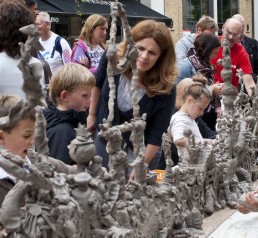
Clayground will be leading two weeks of free workshops at Morley Gallery celebrating global and local links through the making of a giant city in clay.  Surrounded by cityscapes and natural features from around the world, a bed of artificial grass will feature in the central area of the gallery offering a level playing field on which to showcase heroes, sporting or otherwise. Factual or fictional!  Clay trainees from Earth Exchange and students from Central St Martins will be helping facilitate creations by members of the public and youth group members from Lambeth and Southwark.

More information here about Morley Gallery and details of workshops in due course: http://www.morleycollege.ac.uk/morley_gallery

Project Clay: a client project for students at Central St Martins

One of Clayground’s motivations is to enthuse a younger generation about clay and making. One way we do this is by encouraging a new cohort of ceramic students to look beyond the studio for ways to engage others in this amazing material. Central St Martins is now one of the only remaining BA specialist ceramic courses in the country. Clayground has been developing links with the ceramic department and was recently invited to give a client brief to a group of students. The brief was the one we had set ourselves: how to source local and global clay and use these materials to create a participatory public artwork responsive to a particular site. Our current focus is the Kings Cross area where the college is now based.

The students rose to the challenge. Alisdair, Isi, Sarah, Sonia and Zoe, under the banner of Action Monkey, set out to improve their knowledge of the place in which they are studying and to get others stuck into clay. They unearthed fascinating details about the history, people and buildings of the area; persuaded the developers to give them clay from the construction site; offered a drop-in making workshop for the public and other students; tested clays and proposed a thoughtful permanent outcome.

As to sourcing world clay, Sonia who comes from Russia, dug clay during her holidays in Sochi on the Black Sea coast and presented this to Clayground at the assessment panel. The project encouraged the students to consider their role and that of the college in its new surroundings and how, through clay, they could take a lead in bringing others together.

You can find Kings Cross stories and more about Action Monkey here:

http://actionmonkeys.wordpress.com/stories-of-kings-cross/

Sonia digging clay in Sochi, Russia

Location of Sochi on Black Sea coast

Black Sea

Map of Russia

Sonia presents the clay from Sochi to Julia and Duncan, Clayground

Firing Up session at Stoke

Clayground is creative adviser to the UK Crafts Council’s Firing Up national programme aimed at bringing redundant kilns back into use and to reviving clay skills.  We have written a handbook for teachers and devised a creative project exploring how personal stories, local or family histories can inspire development of clay skills and celebrate connections to specific places.  We firmly believe, if clay is to be put back in the art-room, it has to be liberated from those confines to renew its central role in broader cultural and civic life.  We have now led Firing Up creative sessions for teachers and artists in partnership with Higher Education institutions in Plymouth, Liverpool, London, Sunderland, Bath and Stoke-on-Trent with Manchester coming up in February.

All sessions have incorporated a visit to a local museum collection and presentations from artists who will be working with schools.  This last week for example, the Firing Up session was held at the Wedgwood Museum in Stoke at the heart of the UK region known as the Potteries.  This gave the opportunity to delve further into the history of Josiah Wedgwood and take on board what an extraordinary contribution he made to cultural and scientific knowledge as well as bringing exceptional ceramic and design innovations to the public.  Alongside his economic achievements, his humanity shines through as a virtual autodidact with insatiable curiosity for the world around him, an affectionate father and committed anti-slavery campaigner.  As if this was not sufficient, he also had his leg amputated while fully conscious, securing his reputation as an all round hero.  For more information: http://www.wedgwoodmuseum.org.uk/home

Josiah Wedgwood (1730-1795) by Joshua Reynolds (1723-1792)

The session also enabled Duncan Hooson (Clayground Co-Director) to contribute to revival of clay skills in his home city Stoke where his own family history is bound up with the history of the Potteries.

CLAY FROM AROUND THE WORLD

A selection of the world's clays gathered to date

A selection of the world's clays gathered to date

Clay diggers and bearers continue to source clay from around the world. Champion clay bearer, Terry Noel, has brought clay from Austria, Norway, Trinidad, Azerbaijan, and Turkey. Collected from countries where he and his band, the BT Melodians, travel to play steel pans.

Terry Noel and Cristo Adonis collect clay in Trinidad

Terry Noel and Cristo Adonis collect clay in Arima, Trinidad

Most recent clay arrivals have been relayed to London by retired medics Bruce and Sarah Noble from a pottery in Marginea, Romania.  The clay was exchanged for a drawing by Bruce of the potter, Corneliu Magopat.

Corneliu Magopat at the wheel.  Ceramica Marginea, Romania

Corneliu Magopat at the wheel. Ceramica Marginea, Romania

Continue reading